
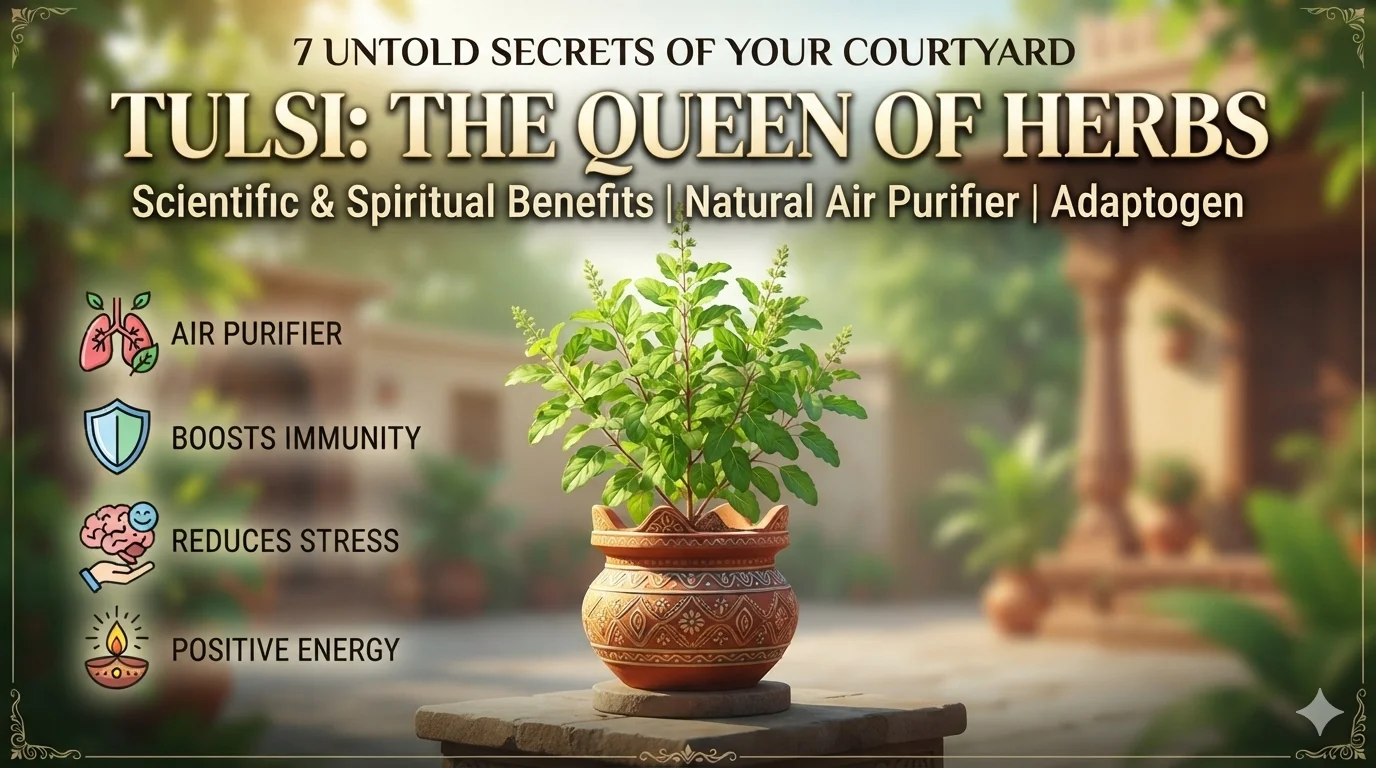
In today’s human environment, Tulsi plant benefits when we depend on expensive devices for pure air and mental peace, have you ever noticed that a small plant growing in our courtyard can be an infinite source of scientific and spiritual power?
Tulsi in the Courtyard: Know Its 7 Amazing and Untold Secrets
Revered in Indian culture, Tulsi is not merely a matter of faith; it represents a remarkable blend of modern science and ancient spirituality. Therefore, the new generation of our society must believe that all the civilizations that developed over time were based on nature. Today, by excessively interfering with nature in the name of science, humanity has moved farther away from it.
“I am the Tulsi of your courtyard.”
How Does Tulsi Purify the Air in Your Home? Know the Secret of Oxygen and Ozone
Tulsi is considered a natural air purifier. According to botanical experts, it releases oxygen in substantial quantities for approximately 12 hours. At the same time, it is believed to help reduce harmful gases such as carbon monoxide, carbon dioxide, and sulfur dioxide present in the environment.
According to research from S.V. University, Tirupati, Tulsi releases ozone gas during respiration, which is considered helpful in keeping the environment clean and reducing the effects of ultraviolet rays. The eugenol present in Tulsi also helps repel mosquitoes and harmful insects.
The scientific name of Tulsi is Ocimum tenuiflorum (Ocimum sanctum).
Why Is Chewing Tulsi Leaves Considered Harmful? Know the Scientific Reason
Elders in our homes often advise against chewing Tulsi leaves with the teeth. It is believed that certain compounds found in Tulsi may have an adverse effect on tooth enamel. Therefore, traditionally, it has been recommended that Tulsi leaves be swallowed directly or consumed with water rather than chewed.
We therefore urge the new generation to listen carefully to the advice of their elders at home and conduct research into the remedies and practices they have shared.
Does Circumambulating Tulsi Increase the Aura? A Surprising Claim from Energy Science
In spiritual traditions, Tulsi is considered a source of positive energy. Some studies and energy-based assessments have claimed that respectfully circumambulating a Tulsi plant may have a positive effect on a person’s energy field or aura.
Although further scientific research is needed on this subject, Tulsi is traditionally regarded in Indian culture as a symbol of mental peace and positivity.
Read more – Dwarikapuri
Why Is Tulsi Called an ‘Adaptogen’? A Natural Remedy for Reducing Stress
Modern scientific research considers Tulsi an effective adaptogen. Adaptogens are natural substances that are believed to help the body adapt to and maintain balance during stress.
Major Benefits:
- Helps reduce mental stress
- Helps strengthen the immune system
- Promotes antioxidant activity in the body
- Helps protect cells from oxidative damage
- Provides relief from cold and cough
- Helps regulate blood sugar
- Improves digestion
- Helps purify the environment
- Helps eliminate toxic substances from food
Importance of Tulsi in Vastu Shastra: Which Direction Is Considered Auspicious?
According to Vastu Shastra, placing a Tulsi plant in the northeast direction, or the Ishaan corner, is considered highly auspicious. This location is believed to promote the flow of positive energy.
Things to Keep in Mind:
- Place Tulsi in the northeast corner.
- Regularly offer a lamp and water.
- It is traditionally advised to avoid placing Tulsi in the southern direction.
What Are the Rules for Plucking Tulsi Leaves? Know the Special Practices Mentioned in the Scriptures
Sanatan traditions prescribe certain special rules regarding Tulsi.
Main Rules:
- Do not pluck Tulsi leaves on Sundays and Ekadashi.
- Avoid touching the Tulsi plant after sunset.
- Tulsi leaves are especially offered in the worship of Lord Vishnu and Lord Krishna.
- Tulsi is generally not offered during the worship of Lord Ganesha and Goddess Durga.
According to the Skanda Purana, Tulsi leaves do not become impure as quickly as other flowers and, under certain circumstances, are considered suitable for reuse.
Read more – What to Eat and How to Live
Medicinal Benefits of Tulsi: Why Is It Called the ‘Queen of Herbs’?
Tulsi is often referred to as the “Queen of Herbs.” Its medicinal properties are considered extensive.
1. Helps Strengthen Immunity
Tulsi helps strengthen the body’s immune system. It contains vitamin C and zinc, which are important for immune function.
2. Beneficial for the Respiratory System
Tulsi has traditionally been used for colds, coughs, and respiratory problems. It is believed to possess antibacterial properties that may help the body fight infections.
3. Supports Heart Health
It is considered helpful in maintaining healthy cholesterol levels.
4. May Support Kidney Health
In traditional medicine, a mixture of Tulsi and honey has been used for problems associated with kidney stones.
5. Beneficial for Skin and Eye Health
The natural properties present in Tulsi are considered helpful in maintaining skin cleanliness and overall skin health.
6. Improves Digestion
Tulsi is believed to help balance acid levels in the body. Eating washed Tulsi leaves on an empty stomach in the morning is traditionally believed to strengthen the digestive system and provide relief from constipation.
7. Helps Reduce Anxiety and Stress
Drinking Tulsi tea or Tulsi-infused water regularly is believed to promote mental peace and reduce stress levels.
How to Consume Tulsi
You can consume 3 to 5 washed Tulsi leaves in the morning on an empty stomach, or boil them in tea or prepare them as a herbal decoction and drink them.
Conclusion: Tulsi Plant Benefits in Hindi — Tulsi Is More Than Just a Plant
Tulsi is not merely an ornamental plant in our courtyard; it is a living symbol of the Indian knowledge tradition, health practices, and spiritual consciousness. It teaches us that living in harmony with nature is the foundation of a healthy and balanced life.
Therefore, we appeal to the new generation to learn more about the natural resources around us and make an effort to live in harmony with nature.
“Tulsi is not an ordinary plant, but a prayer that breathes.”
“I Am the Tulsi of Your Courtyard…”
Today, when the world is searching for purity, good health, and mental peace, this divine plant in our courtyards reminds us to return to our roots.
If you liked this blog post, please share it with others.