
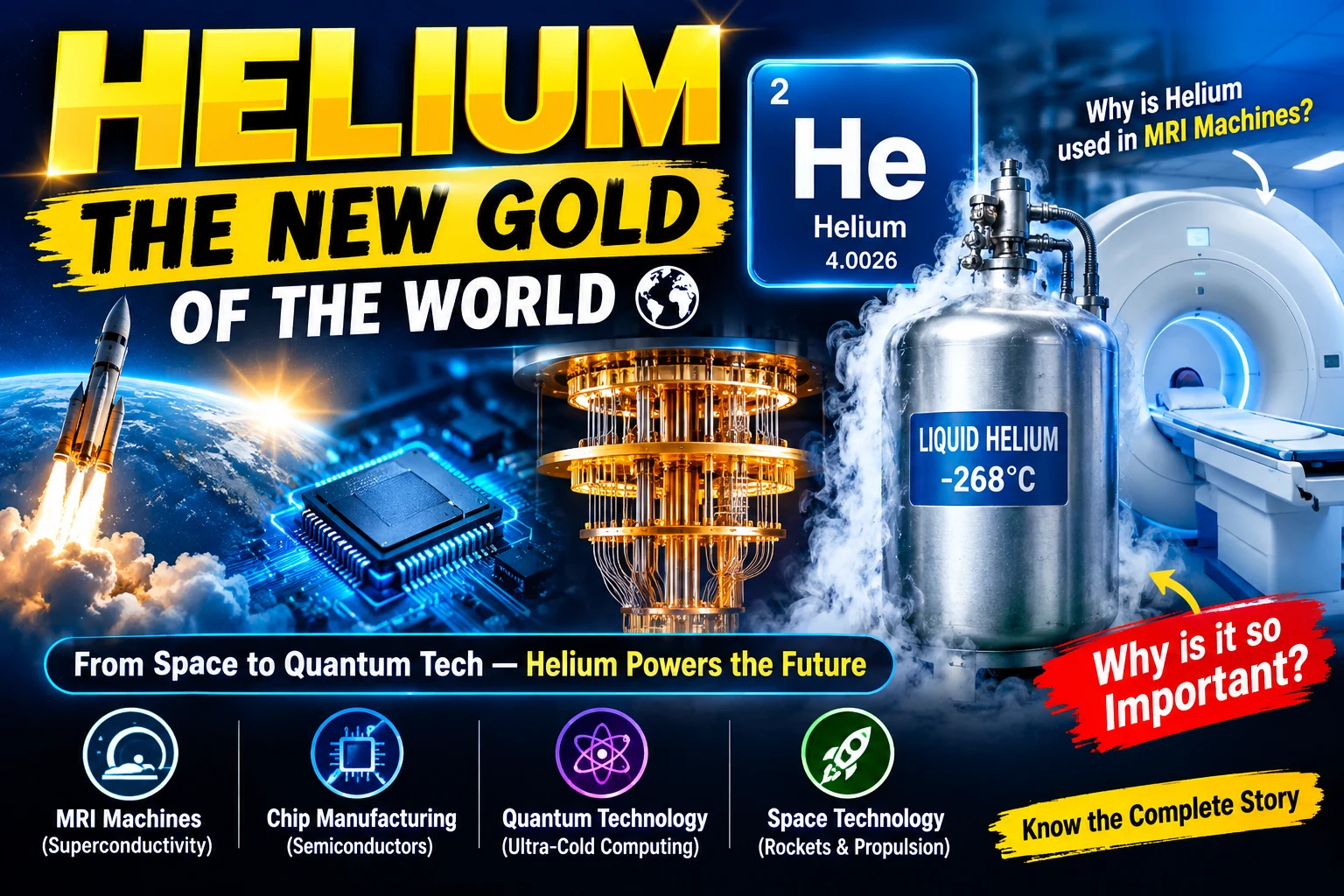
Helium: The New Gold of the World Learn what helium is, why it is used in MRI machines, and what role it plays in superconductivity, chip manufacturing, quantum technology, and space technology. Read the complete information.
Jai Hind! How many of you know that an MRI machine can never simply be switched off? If an MRI machine is shut down, it can cost anywhere from ₹30 lakh to ₹40 lakh to restart. What is the reason? The reason is a gas that is being called the “gold” of the present time. It is also the second-lightest gas in the world. Today, we are going to talk about helium.
What is Helium?
Helium is a gas that was once studied simply as an inert gas belonging to Group 18 of the Periodic Table. However, today this same gas is making headlines.
Helium is called an inert gas, meaning that it generally does not react easily with other substances. Today, helium is appearing in newspaper headlines, and it is sometimes said that whoever has access to helium will have an advantage in the future. Read more – Japan tooth regrowth drug
Helium is a gas that science cannot manufacture economically on a large scale; it is naturally produced by geological processes. That is why helium is sometimes referred to as “light gold.”
The first thing to understand is that helium is a gas. Gases can broadly be thought of as substances that react readily and those that do not. Since helium is extremely unreactive, it is classified as an inert gas.
How Did Helium Get Its Name?
The story of how helium got its name is quite interesting.
Helium was first discovered through observations of the Sun, rather than on Earth. Helium is present on Earth, but there is very little of it in the atmosphere. Because helium is extremely light, when it escapes into the atmosphere, it can eventually rise into space.
The name helium comes from Helios, the Greek word for the Sun. While scientists were studying the Sun, they detected an unknown element in the solar spectrum in addition to hydrogen. This previously unknown element was later named helium.
How Is Helium Formed on Earth?
Large amounts of radioactive elements such as uranium exist inside the Earth. During radioactive decay, these elements release alpha particles.
Alpha particles are essentially helium nuclei. Over very long periods of time, these particles can acquire electrons and form helium atoms. Geological processes can then trap the helium underground, particularly in natural-gas reservoirs.
This is why helium is considered a naturally occurring resource. Unlike many industrial gases, it cannot simply be manufactured economically in large quantities through ordinary chemical processes.
Why Is Helium So Important?
India currently depends heavily on imported helium.
One of helium’s most important properties is its extremely low boiling point. Liquid helium boils at about −269°C (4.2 K) at atmospheric pressure. If its temperature rises above its boiling point, it turns into a gas.
For comparison, liquid nitrogen boils at approximately −196°C.
When equipment needs to be maintained at extremely low temperatures, liquid helium can therefore be extremely useful.
What Does Helium Do in an MRI Machine?
The full form of MRI is Magnetic Resonance Imaging.
An MRI machine contains a very powerful superconducting magnet. To maintain superconductivity, the magnet’s coils are cooled to extremely low temperatures.
Liquid helium is used as a cryogenic coolant for many superconducting MRI magnets. When the magnet is cooled to temperatures close to −269°C, the superconducting material can operate with extremely low electrical resistance.
In the superconducting state, electrical current can continue flowing with very little energy loss. This allows MRI systems to maintain strong and stable magnetic fields.
If the magnet warms significantly, superconductivity can be lost. In an event known as a quench, liquid helium can rapidly boil into gas and escape from the cryogenic system. Restarting and restoring an MRI system after a serious quench can be extremely expensive, depending on the machine and the extent of the damage.
Modern MRI systems therefore use cryocoolers and other systems to reduce helium loss and maintain the required low temperatures.
What Is Superconductivity?
Superconductivity is a state in which certain materials exhibit essentially zero electrical resistance below a particular critical temperature.
When an appropriate superconducting circuit is cooled to an extremely low temperature, electrical current can flow with almost no resistance and therefore with very little energy loss.
This property is one of the main reasons superconducting materials are used in extremely powerful magnetic systems such as MRI machines and certain scientific instruments.
Importance of Helium in Chip Manufacturing
Today, the entire world is engaged in the race for artificial intelligence (AI) and advanced semiconductor technology.
The manufacturing of modern chips involves highly controlled environments and sophisticated processes. Helium can be used in several semiconductor-manufacturing and electronics processes because of its chemical inertness, thermal properties, and ability to provide controlled atmospheres and cooling.
For this reason, helium is not limited to the medical sector. It also has applications in modern electronics and semiconductor manufacturing.
Helium in Quantum Technology
Everyone knows about conventional computers. But another major field of computing is quantum computing.
India is also working on quantum technology through its National Quantum Mission.
Some quantum processors, particularly systems based on superconducting circuits, need to operate at extremely low temperatures. Such systems require sophisticated cryogenic technology, often involving helium-based cooling systems.
Therefore, helium and helium-based cryogenics can play an important role in certain quantum-computing technologies.
Helium in Space Technology
Helium is also used in space technology.
It can be used in rocket systems for purposes such as pressurizing and managing propellant tanks and supporting cryogenic propulsion systems. Helium’s low reactivity and ability to remain gaseous under certain conditions make it useful for these applications.
For this reason, helium is an important industrial gas in parts of the aerospace and space sector.
Countries That Produce Helium
Only a limited number of countries have significant helium production.
The United States and Qatar are among the world’s major helium producers, while other countries also produce smaller quantities.
Because helium resources are geographically concentrated, global supply can be vulnerable to production disruptions, making helium an important strategic resource for industries that depend on it.
Does India Produce Helium?
India does not currently have large-scale commercial helium production comparable to the world’s major producers.
There have been reports and studies concerning helium occurrences in parts of India, including areas of West Bengal, but such occurrences should not be confused with large-scale commercial production.
India is therefore largely dependent on imports to meet its helium requirements.
The claim that a particular location in West Bengal is producing significant commercial quantities of helium should be treated cautiously unless supported by official geological or government data.
Why Has China’s Helium Situation Become a Topic of Discussion?
A significant portion of the world’s helium supply comes from a relatively small number of producers. As a result, global supply and trade policies surrounding helium are closely watched.
China has a rapidly growing demand for helium because of its semiconductor, electronics, aerospace, medical, and scientific industries.
However, claims that China has completely banned helium exports specifically because it wants to reserve helium for chip manufacturing require careful verification. Helium trade is influenced by international supply, domestic demand, contracts, regulations, and broader geopolitical developments.
Why Is There Growing Competition Over Helium?
The demand for helium is connected to several high-technology industries, including:
- – Semiconductor manufacturing
- – MRI and medical imaging
- – Scientific research
- – Superconducting technologies
- – Quantum computing
- – Aerospace and space technology
- – Cryogenic applications
At the same time, helium is a finite natural resource that is difficult to replace in some applications.
The global semiconductor and technology competition between major economies has therefore increased attention toward critical materials and gases, including helium.
Why Does India Need Helium?
India is expanding its capabilities in areas such as:
- – Semiconductor manufacturing
- – Artificial intelligence
- – Quantum technology
- – Space exploration
- – The Gaganyaan human-spaceflight programme
- – Advanced scientific research
All of these sectors can involve technologies that require cryogenic systems or specialized industrial gases.
India therefore needs a reliable and diversified supply of helium. Since India currently relies substantially on imports, securing stable international supplies is strategically important.
Rising Demand and Helium Prices
As more countries develop semiconductor, aerospace, medical, quantum, and advanced research capabilities, demand for helium can increase.
Helium cannot simply be manufactured in unlimited quantities like many ordinary industrial gases. Most commercially usable helium is recovered from underground natural-gas deposits where it accumulated over geological timescales.
This makes helium a strategically important natural resource.
Conclusion
Today, helium has become an important resource in the global competition surrounding AI, semiconductors, advanced electronics, medicine, quantum technology, and space exploration.
There was a time when helium was simply a topic in science textbooks. Today, it has practical applications in MRI machines, superconductivity, chip manufacturing, quantum computing, aerospace, and many other advanced technologies.
Because of its unique properties, limited natural availability, and importance in high-technology industries, helium is sometimes described as “the new gold” or “light gold.”
As technology continues to develop and demand for advanced systems grows, the strategic importance of helium is likely to remain significant.