
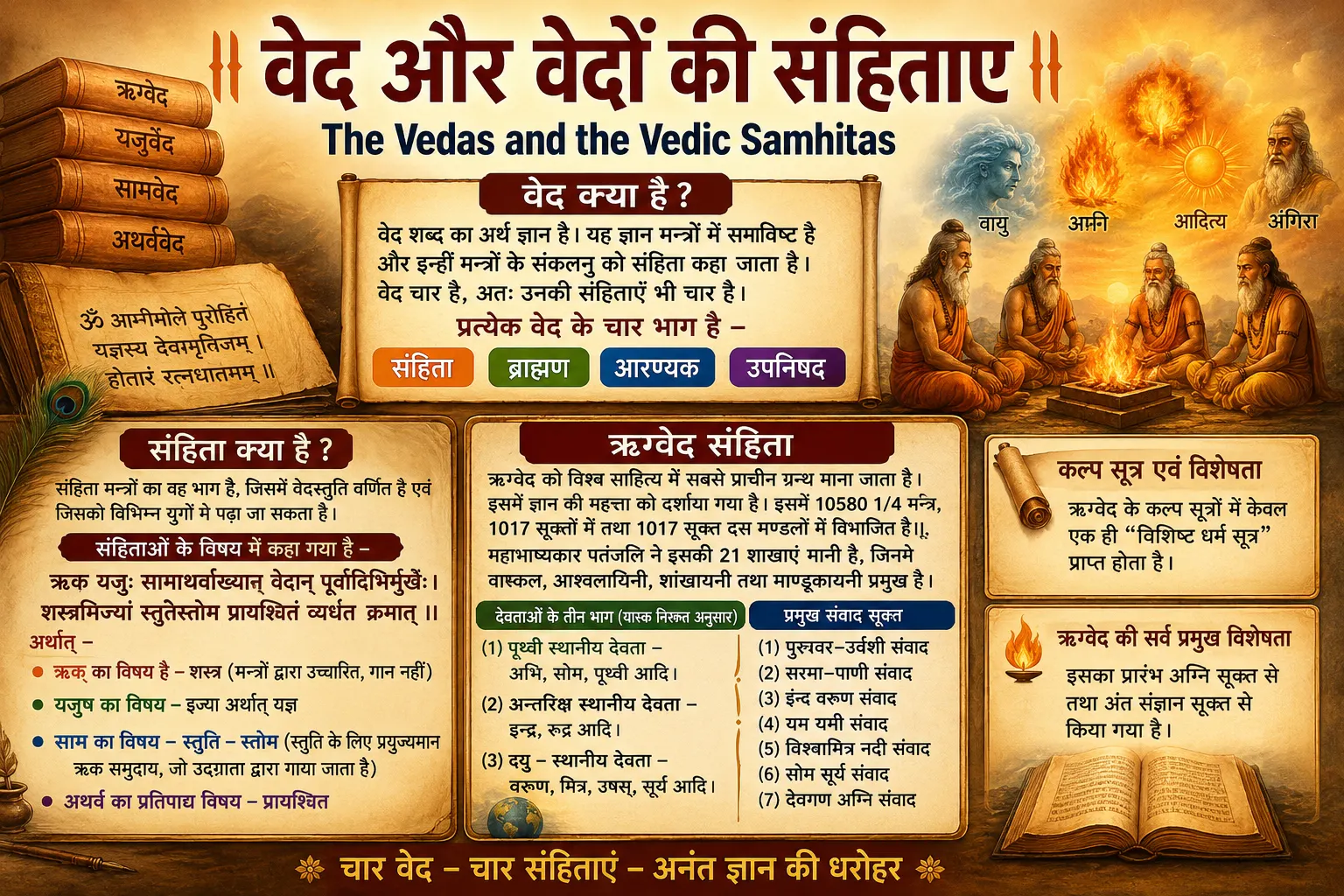
Rigveda Interesting Facts: Ancient Hindu Knowledge Explained: वेद और वेदों की संहिताओं का विस्तृत अध्ययन पढ़ें। जानें ऋग्वेद संहिता, शाखाएँ, संवाद सूक्त, देवताओं का वर्गीकरण तथा वेदों के चार भागों की सम्पूर्ण जानकारी हिंदी एवं अंग्रेज़ी में।

वेद और वेदों की संहिताए :-
वेद शब्द का अर्थ ज्ञान है। यह ज्ञान मन्त्रों में समाविष्ट है और इन्हीं मन्त्रों के संकलन को संहिता कहा जाता है। वेद चार है, अतः उनकी संहिताएँ भी चार है। प्रत्येक वेद के चार भाग है –
- संहिता,
- ब्राह्मण,
- आरण्यक
- उपनिषद
Explained in English –
Learn Vedas online and Rigveda interesting facts :-
Vedas and Vedic Samhitas :-
The word ‘Veda’ signifies knowledge. This knowledge is embodied within mantras, and the compilation of these very mantras is known as a Samhita. There are four Vedas; consequently, there are also four Samhitas. Each Veda consists of four parts:
- Samhita,
- Brahmana,
- Aranyaka, and
- Upanishad
संहिता मन्त्रों का वह भाग है, जिसमें वेदस्तुति वर्णित है एवं जिसको विभिन्न युगों मे पढ़ा जा सकता है।
संहिताओं के विषय में कहा गया है —
“ऋक यजुः सामाथर्वाख्यान् वेदान् पूर्वादिभिर्मुखै:।
शस्त्रमिज्यां स्तुतिस्तोम प्रायश्चितं व्यधात क्रमात ।।
अर्थात् –
ऋक् का विषय है-शस्त्र । शस्त्र उसे कहते हैं जो मन्त्रों द्वारा उच्चारित होता है तथा जिसका गान नहीं किया जा सकता। यजुष का विषय ‘इज्या अर्थात यज्ञ है तथा साम का विषय है – स्तुति – स्तोम अर्थात् स्तुति के लिए प्रयुज्यमान ऋक समुदाय, जो उद्गाता द्वारा गाया जाता है। अथर्व का प्रतिपाद्य विषय है – प्रायश्चित। Read more – वर्षा सुंदरी के प्रति
Explained in English –
The Samhita constitutes that section of the mantras in which the hymns of praise to the Vedas are enshrined—a section that may be recited across various epochs. It has been said about the codes –
“Rik Yajuh Samatharvakhyan Vedan Purvaadibhirmukhai.
Shastramijyaam stutistom prayaschitam vyadhaat kramaat.”
That is –
The subject of Rik is weapons. Shastra is that which is pronounced through mantras and which cannot be sung. The subject of Yajush is ‘Ijya’ i.e. Yagya and the subject of Sama is – Stuti – Stom i.e. the group of Rikas used for praise, which is sung by the Udgata. The theme of Atharva is repentance.
ऋग्वेद संहिता :-
ऋग्वेद को विश्व साहित्य में सबसे प्राचीन ग्रन्थ माना जाता है। ऋग्वेद में ज्ञान की महत्ता को दर्शाया गया है। सृष्टि के आरम्भ में ईश्वर ने वेदों का ज्ञान वायु, आग्नि, और आदित्य, अंगिरा नामक चार ऋषियों को प्रदान कर दिया था। चारों ऋषियों ने अपने पुत्रों तथा अन्य ऋषियों को ज्ञान दिया अन्ततः यह ज्ञान विस्मृत होने लगा तो इसे लिपिबद्ध कर लिया गया। इस प्रकार जिस ऋषि को जितना ज्ञान प्राप्त रह गया वह ऋषि उन मन्त्रों का मंत्रद्रष्टा कहलाया। इस प्रकार वेद मंत्रों का संग्रह किए जाने के कारण वेदों को ‘संहिता‘ नाम से भी पुकारा जाने लगा। ऋग्वेद के 10580 1/4 मन्त्र, 1017 सूक्तों में तथा 1017 सूक्त दस मण्डलों में विभाजित हैं।।
Explained in English –
Rig Veda Code :-
Rigveda is considered to be the oldest text in world literature. The importance of knowledge has been shown in Rigveda. At the beginning of creation, God had imparted the knowledge of Vedas to four sages named Vayu, Agni, Aditya and Angira. The four sages imparted knowledge to their sons and other sages and eventually this knowledge began to be forgotten, so it was written down. In this way, the sage who gained as much knowledge as he could was called the seer of those mantras. In this way, due to the collection of Veda mantras, the Vedas also came to be called ‘Samhita’. Rigveda has 10580 1/4 mantras, divided into 1017 suktas and 1017 suktas are divided into ten mandalas.
महाभाष्यकार पंतजलि ने ऋग्वेद की 21 शाखांए मानी है। जिसमें वाष्कल आश्वलायिनी, शांखायनी तथा माण्डूकायनी प्रमुख शाखाएँ है।
यास्क ने निरुक्त में देवताओं को तीन भागों मे रखा है।
( 1 ) पृथ्वी स्थानीय देवता – अग्नि, सोम, पृथ्वी आदि ।
(२) अन्तरिक्ष स्थानीय देवता- इन्द्र, रुद्र आदि।
(3) द्यु – स्थानीय देवता – वरुण, मित्र, उषस्, सूर्य आदि।
ऋग्वेद में लगभग २० सूक्त ऐसे हैं, जिन्हें “संवाद सुक्त” कहा जाता है। इनमें प्रमुख सूक्त निम्नलिखित है।
( 1 ) पुरुरवा-उर्वशी संवाद
( 2 ) सरमा-पाणी संवाद
( 3 ) इंद्र वरुण संवाद
( 4 ) यम यमी संवाद
( 5 ) विश्वामित्र नदी संवाद
( 6 ) सोम सूर्य संवाद
( 7 ) देवगण अग्नि संवाद
Explained in English –
Mahabhashyakar Patanjali has considered 21 branches of Rigveda. In which Vashkal Ashvalayini, Shankhayani and Mandukayani are the main branches.
Yasaka has divided the gods into three parts in Nirukta.
(1) Earth Local Gods – Abhi, Som, Prithvi etc.
(2) Space local deities – Indra, Rudra etc.
(3) Dyu – Local deities – Varun, Mitra, Ushas, Surya etc.
in Rigveda There are approximately 20 hymns known as “Dialogue Hymns” (*Samvada Suktas*). The most prominent among these are as follows:
(1) The Pururavas-Urvashi Dialogue
(2) The Sarama-Pani Dialogue
(3) The Indra-Varuna Dialogue
(4) The Yama-Yami Dialogue
(5) The Vishwamitra-River Dialogue
(6) The Soma-Surya Dialogue
(7) The Devas-Agni Dialogue
ऋग्वेद के कल्प सूत्रों में केवल एक ही “विशिष्ट धर्म सूत्र” प्राप्त होता है
ऋग्वेद की सर्व प्रमुख विशेषता यह है कि इसका प्रारंभ अग्नि सूत्र से तथा अंत संज्ञान सूक्त से किया गया है।
Explained in English –
Among the *Kalpa Sutras* associated with the Rigveda, only one “Specific Dharma Sutra” is extant.
The most distinctive feature of the Rigveda is that it commences with the *Agni Sukta* (Hymn to Agni) and concludes with the *Samjnana Sukta* (Hymn of Concord).
If you liked the content, please be sure to leave a comment in the comment box.