
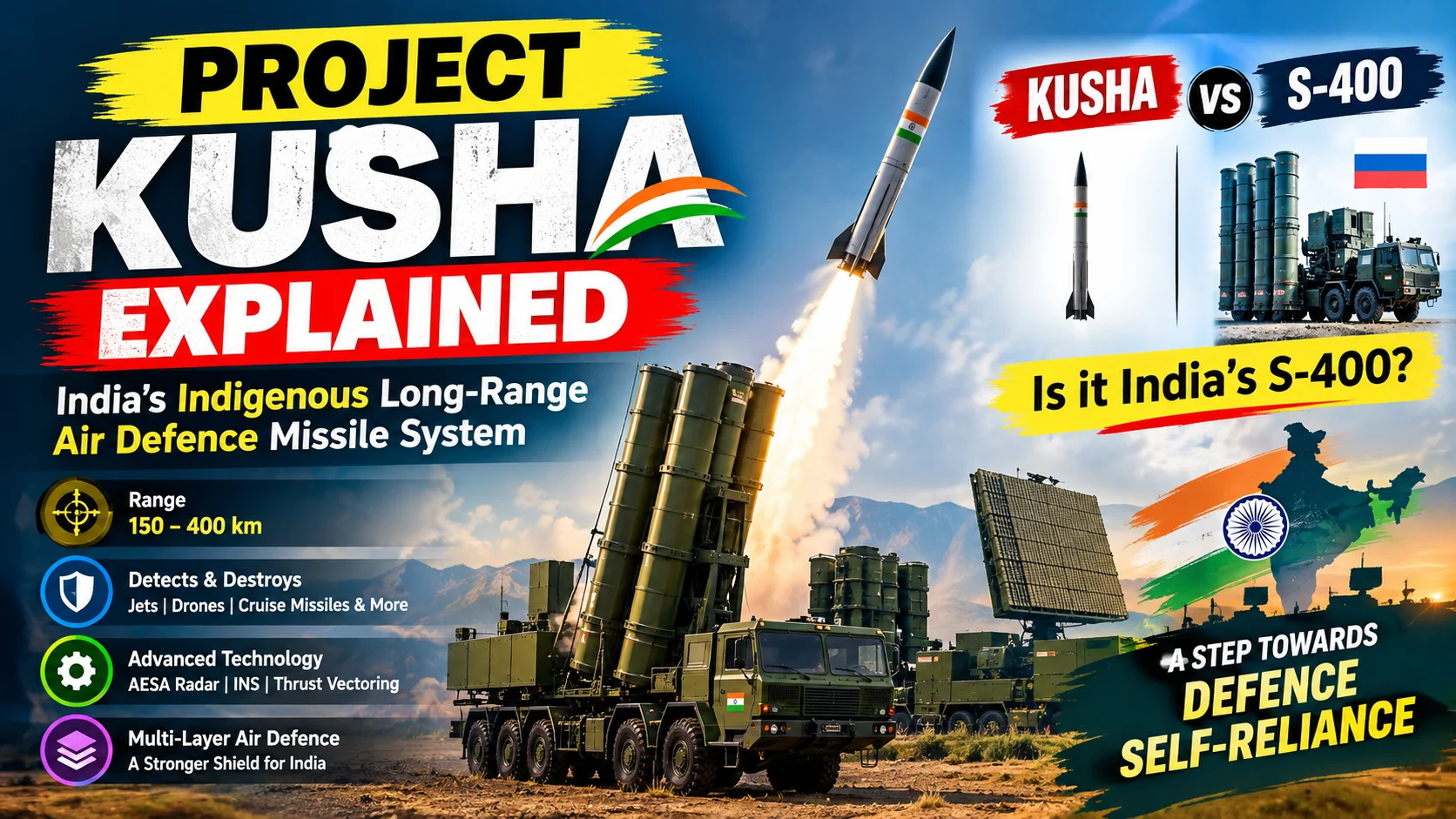
Project Kusha vs S-400: Know about India indigenous long-range air defence system Possible range, technology, role of DRDO and comparison with S-400.
Project Kusha indigenous long range air defence system India
India is rapidly moving toward strengthening its defence capabilities and reducing dependence on foreign weapon systems. In this context, Project Kusha is being seen as India’s indigenous long-range air defence missile system.
The objective of Project Kusha is to detect and destroy various aerial threats coming from an adversary—such as cruise missiles, drones, fighter jets, and other flying targets—from long distances.
This is why Project Kusha is often being compared with Russia’s S-400 air defence system. But has India really developed its own S-400? Let us understand what Project Kusha is, how capable it could be, and what significance it may have for India’s defence strategy.
Read more – Japan Tooth Regrowth Drug
What is Project Kusha?
Project Kusha is an indigenous long-range surface-to-air missile defence system being developed under the leadership of the DRDO (Defence Research and Development Organisation).
Its main objective is to strengthen India’s multi-layered air defence capability so that the country’s borders and critical installations can be protected from long-range aerial threats.
Project Kusha is considered an important part of India’s broader future air-defence vision, including concepts such as Mission Sudarshan/Sudarshan Chakra.
When did Project Kusha begin?
The Government of India gave major approval for the development of Project Kusha. The objective is to introduce an indigenous long-range interceptor missile system into India’s air-defence network in the coming years.
The project is being developed with the participation of the DRDO, major Indian defence companies, and private-sector companies.
What will be the range of Project Kusha missiles?
Project Kusha is being developed with multiple interceptor variants to deal with threats approaching from different distances.
Broadly, three levels are discussed:
- M1 Interceptor: approximately reported 120–150 kilometres
- M2 Interceptor: approximately reported 250 kilometres
- M3 Interceptor: up to around reported 350–400 kilometres
In this way, Project Kusha aims to create a strong defensive shield capable of countering aerial threats ranging from relatively shorter distances to very long ranges.
How will Project Kusha work?
The most important part of a modern air-defence system is not just the missile but the entire Detection, Tracking and Engagement Network.
Radars and ground-based command systems will play an important role in Project Kusha as well.
1. Target Detection
First, the radar detects an incoming aerial target. The target could be a fighter jet, drone, cruise missile, or another airborne object.
2. Continuous Tracking
If the target changes direction, the system continuously tracks its updated coordinates and movement.
3. Interceptor Launch
Based on the target’s position and trajectory, an interceptor missile is launched.
4. Target Engagement
During flight, the missile continues to receive the necessary guidance and tracking information, allowing it to intercept targets even when they change direction.
What technologies are being used in Project Kusha?
Project Kusha is being developed with modern air-defence requirements in mind. Several advanced technologies have been discussed in connection with the system.
Thrust Vectoring Technology
The use of technologies such as thrust vectoring can help improve the missile’s directional control and flight manoeuvrability.
This can allow the interceptor to manoeuvre more effectively during flight.
Inertial Navigation System
An Inertial Navigation System (INS) plays an important role in missile navigation and guidance.
It provides the missile with information about its position and direction during flight.
Active Electronically Scanned Array (AESA)
Modern radar technology is important for target detection and engagement, particularly during the terminal phase.
AESA-based systems can help track multiple targets rapidly and respond according to their positions.
Can Project Kusha target stealth aircraft?
Stealth aircraft are designed in such a way that they are difficult to detect using conventional radar systems.
Therefore, one of the biggest challenges for modern air-defence systems is detecting, tracking, and engaging targets with a low radar cross-section.
Project Kusha’s development is reportedly focused on capabilities that could make it effective against modern and low-observable aerial targets as well.
However, saying that a stealth aircraft is “completely invisible to radar” is technically incorrect. The purpose of stealth technology is to make radar detection more difficult, not impossible.
Project Kusha vs S-400: Are they the same?
Project Kusha is often compared with Russia’s S-400 Triumf air-defence system.
The S-400 is one of the world’s major long-range surface-to-air missile systems. India acquired it from Russia to strengthen its air-defence capabilities.
However, it would not be accurate to call Project Kusha a direct copy of the S-400. The two systems may differ in terms of architecture, missiles, radar networks, deployment, and operational capabilities.
Range Comparison
Different Project Kusha interceptors are reportedly being developed to cover ranges of approximately 150, 250, and up to 400 kilometres.
The S-400, meanwhile, uses different types of missiles, with its maximum engagement range reported to be around 400 kilometres.
Therefore, the fact that both systems may have a range of around 400 kilometres does not make them identical.
Speed Comparison
The various missiles used by the S-400 have different speeds, and some interceptors can reach extremely high speeds.
Project Kusha interceptors are also being designed for high-speed engagements, but their actual operational performance can be assessed more accurately only after full development and official testing.
Will Project Kusha be better than the S-400?
It is too early to say that Project Kusha is better than the S-400.
The biggest potential advantage of Project Kusha for India is indigenisation. It could help India:
- Reduce dependence on foreign systems.
- Promote the domestic defence industry.
- Increase self-reliance in spare parts and maintenance.
- Make it easier to modify the system according to Indian requirements.
- Create opportunities for the export market in the future.
Therefore, instead of calling Project Kusha “India’s S-400,” it is more appropriate to view it as India’s own indigenous long-range air-defence capability.
Role of Project Kusha in India’s Multi-Layered Air Defence
India aims to develop a multi-layered air-defence architecture in the future, in which different systems operate at different ranges and altitudes to counter incoming threats.
Various ballistic missile defence and surface-to-air missile systems can play important roles in these different layers.
Project Kusha could play an important role in strengthening the long-range layer of this network.
This would allow India to attempt to intercept a threat at an early stage if it approaches from a long distance.
Which companies are involved in Project Kusha?
A major defence project such as Project Kusha cannot be built by a single organisation. The supply chain involving the DRDO, government-owned defence companies, and the private sector is important.
Companies such as Bharat Electronics Limited (BEL) and Bharat Dynamics Limited (BDL) may have important roles within this ecosystem.
In addition, several MSMEs and private companies can contribute to different components, subsystems, and manufacturing requirements.
India’s defence-manufacturing capability means that the importance of Project Kusha extends beyond just a single missile system.
Over the past few years, India has placed considerable emphasis on defence manufacturing and indigenous defence production.
Systems such as Tejas, Akash, Pinaka, and BrahMos demonstrate India’s growing defence-production capabilities in this direction.
Some defence systems developed by India have also attracted interest and orders from foreign countries. This is contributing to the expansion of India’s defence-export market.
Project Kusha and India’s Defence Export Market
If Project Kusha is successfully developed and operationalised, it could create a new defence-export opportunity for India in the future.
Amid growing security concerns in the Indo-Pacific region and increasing spending by countries on air-defence systems, an indigenous Indian system could potentially become an option in the international market.
However, the success of any major defence export depends on much more than technology. Factors such as:
- Cost
- Reliability
- Production capacity
- Maintenance support
- Training
- Long-term logistics
will also be important.
Defence Sector and the Indian Stock Market
An important aspect of the Project Kusha story is its connection with India’s defence sector and stock market.
Investor interest in India’s defence sector has increased significantly over the past few years. There are several reasons behind this.
1. Government Policy Support
The Government of India has consistently emphasised defence manufacturing and Atmanirbhar Bharat.
Higher defence spending and policies promoting domestic procurement and production are creating significant opportunities for defence companies.
2. Growth in Defence Production
India’s defence production has increased considerably over the past few years.
Large defence orders, indigenous procurement, and expansion of manufacturing capacity are helping the defence-industry ecosystem grow rapidly.
3. Increase in Defence Exports
India no longer wants to remain only a buyer of defence equipment. It is also moving toward becoming an exporter of defence products.
Systems such as BrahMos, Akash, and Pinaka are examples of this changing landscape.
What Should Investors Understand Before Investing in Defence Stocks?
As interest in the defence sector increases because of its growth prospects and government policies, investor attention toward defence stocks is understandable.
However, before investing in any defence stock, simply looking at the sector’s growth story is not sufficient.
Investors should also examine a company’s:
- Valuation
- Order book
- Revenue growth
- Profitability
- Debt
- Cash flow
- Execution capacity
- Export potential
Instead of investing in a single company, diversified investment products or index-based approaches may also be an option for some investors seeking exposure to the defence sector.
Why is Project Kusha Important for India?
Project Kusha is not merely a missile project. It is part of the larger story of India’s defence self-reliance.
If India can successfully develop and deploy a modern long-range air-defence system on a large scale, it could significantly strengthen the country’s strategic autonomy.
Its potential benefits include:
- Reducing dependence on foreign defence systems
- Promoting domestic defence manufacturing
- Achieving greater self-reliance in advanced technologies
- Creating new opportunities for the private sector and MSMEs
- Expanding defence exports
- Strengthening India’s multi-layered air-defence network
Conclusion: Is Project Kusha India’s S-400?
Calling Project Kusha India’s “Indigenous S-400” is an easy comparison, but technically it would not be appropriate to treat the two systems as identical.
The S-400 is an operational Russian air-defence system, while Project Kusha is an important Indian programme aimed at developing an indigenous long-range air-defence capability.
The real strength of Project Kusha is not only its potential range of up to 400 kilometres, but also its potential contribution to indigenous technology, multi-layered air defence, advanced radar and missile-guidance technology, and India’s domestic defence-manufacturing ecosystem.
If Project Kusha is successfully developed and deployed according to its intended objectives, it could represent a major step forward for India’s defence self-reliance.
That is why Project Kusha should not be viewed merely as a missile system, but as part of the broader story of India’s growing defence technology capabilities and strategic self-reliance.