
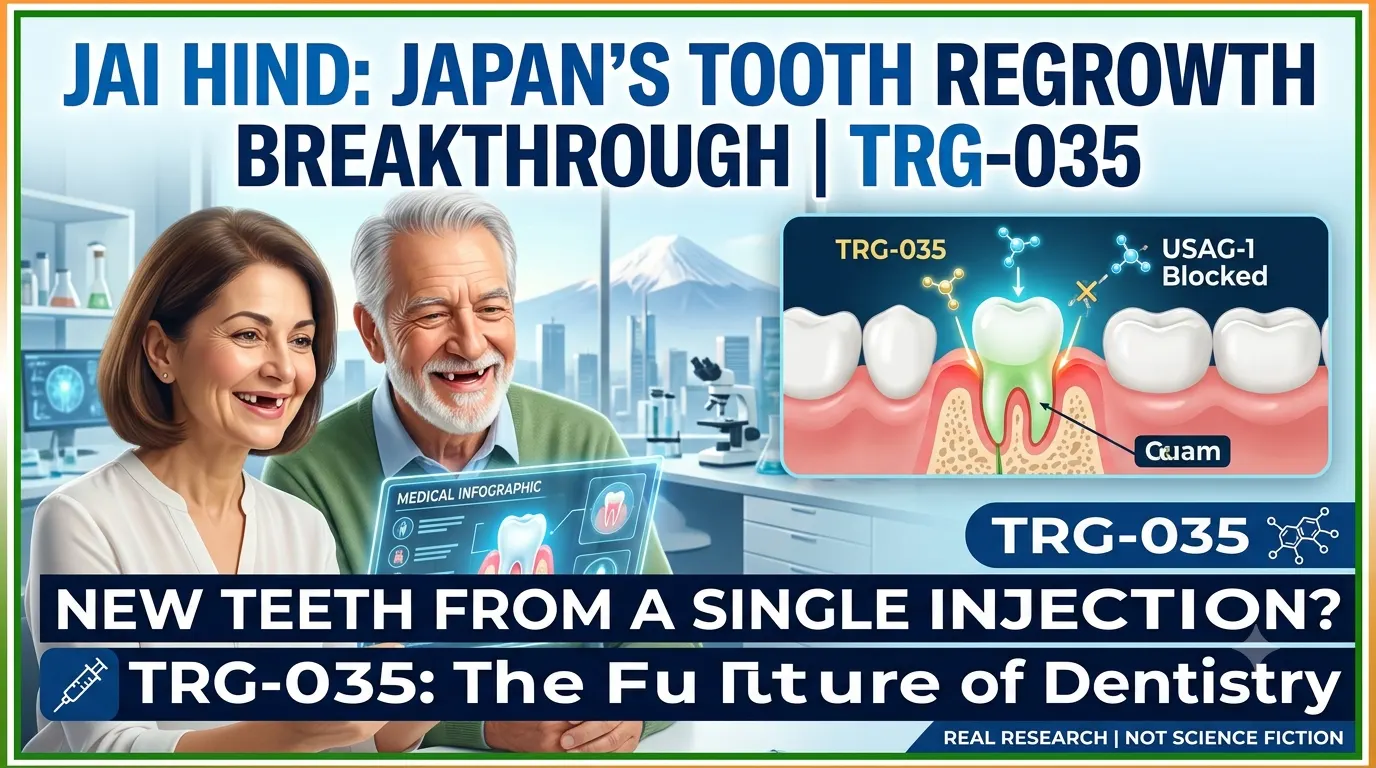
Jai Hind: In Japan, new natural teeth are reportedly being grown using just one injection of the Japan Tooth Regrowth Drug. This is not science fiction, but real scientific research being conducted in Japan. The day may not be far when, at the age of 50, a new tooth could grow in the place of an old one, much like a radish growing from the ground.
Japanese scientists have developed an experimental antibody drug called TRG-035.
TRG-035 Regrow Teeth: How Does the Drug Work?
In what could be a groundbreaking development in dentistry, the drug known as TRG-035 plays an important role. The drug interacts with a specific protein called USAG-1, helping initiate the formation of tooth germs that can potentially develop into new teeth.
Targeting the USAG-1 Protein
TRG-035 blocks the activity of the USAG-1 protein. By doing so, it removes an important biological barrier that normally prevents the development of additional sets of teeth after childhood and adulthood.
Reactivation of Tooth Buds
Once USAG-1 is inhibited, dormant tooth buds may be reactivated. This can initiate biological processes similar to those involved in early tooth development, potentially allowing new teeth to form and erupt in areas where teeth are missing. Read more – Brics summit 2026
Treatment Through Intravenous Injection
Unlike dental implants, TRG-035 is administered through an intravenous injection. This method of delivery allows the drug to enter systemic circulation and target the relevant biological pathway.
Researchers believe that this discovery could prove to be a major benefit for dental patients by potentially increasing the body’s ability to regenerate teeth and offering an opportunity for a new approach to tooth replacement.
Japan Tooth Regrowth Drug TRG-035: A Ray of Hope
Before being tested in humans, TRG-035 was reportedly studied in mice, ferrets, and dogs. The results were described as highly promising.
1. Testing in Mice:
Initial TRG-035 experiments focused on mice because their genetic makeup is well studied and their life cycle is relatively short. Researchers observed successful tooth development without significant adverse effects in the experimental studies.
2. Ferret Testing:
After promising results in mice, TRG-035 was tested in ferrets. Ferrets were selected because their dental structures have similarities to those of humans. The experimental results indicated that new teeth could develop effectively.
3. Testing in Dogs:
Finally, the drug was also studied in dogs, providing researchers with additional information about its potential across different mammalian species. Functional tooth development was reportedly observed in the experimental animals.
The positive results obtained in different animals suggest that TRG-035 may have potential for use in humans. However, this potential still needs to be established through human clinical trials, particularly with regard to safety and effectiveness.
Expert Opinions and Future Challenges in Tooth-Regeneration Research
Experts’ Perspective
- Professor Angré Kong of Queen Mary University of London: Described the research as exciting and worth pursuing, while also emphasizing that this is not a short race but more like “two consecutive ultramarathons.”
- Dr. Chengfei Zhang: Highlighted the revolutionary but somewhat controversial nature of TRG-035 and stressed the need for rigorous testing to ensure that the treatment can be broadly and safely applied.
Future Challenges
Experts believe that the development of TRG-035 and other tooth-regeneration therapies will face several challenges:
- Ensuring long-term safety through extensive clinical testing.
- Addressing ethical considerations in potential treatment applications.
- Meeting global regulatory requirements for efficacy, safety, manufacturing, and quality control.
Japanese scientists have begun testing the treatment in humans for the purpose of regenerating lost teeth. If the results are as hoped, it could eventually open the door to new solutions for tooth loss, potentially including availability in countries such as India. Read more – New Gold
What Various Sources Say
Nakao K. et al., “Tooth regeneration by cell transplantation,” Scientific Reports (2023).
National Institute for Materials Science (NIMS), Japan – June 2024:
NIMS News Release
The Japan Times – “Japan starts first clinical trial of drug aimed at regrowing lost teeth” (June 2024):
The Japan Times article
BBC News – “Japan launches world’s first clinical trial to regrow lost teeth” (June 2024):
BBC News article
Nature – “Inhibition of USAG-1 promotes tooth regeneration through increased BMP signaling” (2021):
Nature article
Japan’s Tooth-Regrowth Drug Expected to Become Available by 2030
If all future clinical trials are successful, researchers reportedly aim to make the drug available to the general public by around 2030. This important development could eventually provide the basis for a natural alternative to artificial dentures and dental implants.
The drug is based on a specific antibody designed to promote the development of new teeth in the body. It works by inhibiting USAG-1, a protein involved in regulating tooth development. By blocking this pathway, researchers hope to encourage the formation of new teeth.
What Is USAG-1?
USAG-1 is a protein involved in regulating and limiting tooth development. Japanese researchers have been investigating how blocking this protein could potentially promote the formation of additional teeth.
What Is TRG-035?
TRG-035 is an antibody drug designed to block USAG-1 and potentially reactivate tooth-development pathways. In simple terms, it is being investigated as a way of encouraging the body to form new teeth.
Japan Is Developing the Tooth-Regrowing Drug TRG-035
The Japanese biotechnology company Toregem Biopharma is developing a drug intended to potentially enable humans to regenerate teeth. The antibody drug TRG-035 targets the USAG-1 protein and aims to promote the biological process involved in the development of new natural teeth.
TRG-035: A Ray of Hope
The Japanese and global scientific communities are excited and hopeful about this research, while also remaining cautious. Only larger and well-controlled clinical trials can determine how safe and effective TRG-035 actually is in humans.
If these trials are successful, the treatment could potentially transform the future of dentistry. In the long term, humans may one day have the ability to regenerate their own natural teeth rather than relying entirely on dentures, bridges, or dental implants.